Big O's Larger Meaning

Malkhos 10-11-2003 12:48 AM
First of all, let me say that I have relatively little experience in Anime than seems to be the case with many members here. I have seen only the episodes of Big O aired on Adult Swim. But I am trained both as a literary critic and as a historian of religion, so I hope I can contribute some useful observations and raise some intersting questions.

1. It seems that the robotic represents in anime what in traditional western literature is signified by the daemonic, something that is niether entirely human or divine. Roger, Dorothy and Big O seem to form a sort of trinity along the lines of Body, Soul and Intellect, representing three phases of existence (physical, spritual, and divine) of a single being. I think once they gain an enlightened self-understanding of how they are related, the story line will reach a resolution similar to that of Patrick MacGoohan's The Prisoner: they will gain access to their memories, all difficulties and concerns that they had will be dispelled as illusions, and they will fulfill whatever their ultimate role is to be.

2. 'negotiator' could well signify mediator, a figure that intercedes between the human and divine worlds, in other words a savior or Jesus.

3. 'Paradigm' could well signify the Platonic Forms, the true ideas that exist behind our accidental and illusorary perceptions that we mistake for relaity. The world of the forms is, of course, equated in Jewish and Christian belief with heaven.Perhaps the unjust tyrannical Paradigm City that we know so far is destinied to be stripped away and its true, just and heavenly nature revealed by Roger/Dorothy/Big O?

4. In Platonism as well as in the Gnostic and Jewish versions of Platonainism, the world as we experience it is made by the demiurge (craftsman), as a necessarily inferior phyiscal copy of the true world of the Forms. In many cases this creator is equated with Satan, and the world is viewed as as a prison designed to keep man from a redemptive return to Heaven. It seems easy to discern these concepts in Paradigm City and the Rosewater family.

5. Dagon, Leviathan, and Behemoth, were Caananite gods defeated and triuphed over by the Judeo-Christian God. I was just reading in another thread that a new characters is about to be intruduced called
spoiler (highlight to read):
Venus--Venus is the traditional Latin equivalent of Astarte, another Caananite god. Perhaps the ultimate conculsion will utilize themes of a quarelling, dangerous 'pagan' pantheon being replaced by a single redeeming God?


6. Megadeus (the pl. form would be Megadei) is a Greek-Latin Hybrid which signifies 'GreatGod.' Why on earth did the English dubbing render this as the meaningless 'megadeuce?' The names Big O, Big Duo, Big Fowl, etc., seem somewhat ridiculous. Are they in fact poor translations, as I suspect, of Buhhdist metaphysical terms? In the brilliant scene near the begining of the second season in which Roger views a play representing his memory of his first encounter with Big O, it seemed as if they wre going to any second reveal that the name meant 'Great Nothingness' or something like that. Dominus, in case anyone does not know, is Latin for 'master.'

7. In Platonic metaphyiscs, memories are not memories of the perceived world of illusion we inhabit, but memories of our true prior existence in heaven. These memories are washed away prior to our incarnation in our body by drinking the waters of the river Lethe (forgetufullness). We spend our lives trying to recover these lost memories through the senses; but the wise man realizes that this is doomed since the original cannot be recalled through a cheap copy, and instead looks within, gathering what snathces of mystic insight he can.

This is surely enough for now.
Sixfortyfive 10-11-2003 12:50 AM
What an entrance!

Yeah, they screwed up the Latin... used Japanese phonetics instead.

Oh, and it's "Big Fau," btw. My thoughts on that:

O = 0
Duo = 2
Fau = 4 (It's close if you think about the Katakana spelling...)
Zopwx2 10-11-2003 12:57 AM
Wow that is pretty in depth. I guess most of us believed that there was some sort of underlying message, especially in the name choice of many of the robots.
"Yeah, but..." 10-11-2003 01:45 AM
OT: It's always nice to know that trained literary critics can watch TV. Big Grin I was trained as one too, and when people found out I liked to watch TV, and cartoons, they'd look at me like my brain had just slid out of my ear.

Your #1 sounds very Plotinian to me. I'll comment more on your post when I've had time to think about.

BTW: You might want to put that info. on the new character in spoiler tags. There are a lot of people on the board who don't know about that yet.

[Edit: Done. --Krang]
R Trusedale 10-11-2003 02:08 PM
quote:
Originally posted by zopwx2
Wow that is pretty in depth. I guess most of us knew there was some sort of underlying message, especially in the name choice of many of the robots. I just didn't have as much knowledge as you.


You didn't know, you believed there was some underlying message. There is a difference. After the very erudite theological treatise here, how much more deeply do you now understand the show? How much does the fact that some giant robots are named after ancient pagan gods really explain?

In ancient times, the theological view was the only way that humanity had of making sense of the world around them. A method of thinking is known as a Paradigm. The theological view was a comforting way of viewing reality, since there was a great parent in the sky watching over you, and more importantly, you could get on with your life without thinking too hard.

Later on there was a Paradigm shift. A new method of thinking arose, based on the use of logic, mathematics, and measurement. The Age of Reason began. This new paradigm caused civilization to advance by leaps and bounds. This new paradigm was much less comforting than the old, since it required greater thought, and no guarantee that a God would be standing by to catch us if we should fall.

In Roger's Paradigm city, complex and incomprehensible technologies abound. If you cannot trust your senses, if the rules of reality can be changed at any time, then perhaps a new third paradigm shift is needed. Or perhaps a retreat to the older first paradigm will satisfy.

Faith, Reason, some mixture of the two, or a new paradigm. Each of us must decide how to view reality.
Zopwx2 10-11-2003 02:34 PM
I never claimed to know anything. I just said that we all noticed that they didn't just pick the robot names at random.
Big Doo-Oh 10-11-2003 03:19 PM
Definately a great anaylsis of Big O's meaning. I've never read the Bible, nor have I looked into any type of Pagan or Judeo-christian literature or philosophy. The only thing I think you missed was the importance of identity in Big O. I can think of at least three episodes where Roger has doubted his role, or who he is and why he is able to pilot the Big O. I like how you noted that Roger's role as "negotiator" can be interepted on a human/divine level, and how Roger, given this role, wishes to live his own life, not controlled and free of what
spoiler (highlight to read):
Major Smith

did in the past.


Interestingly enough, he picked up upon whats going to happen in the end without even watching the spoiler clips.


By the way, the dubbers changed it to "megadeuce" and "Cast in the name of good, ye not gulity" for the orignal Toonami run, since parents and censors didn't want any religous context.
GoGoArlo 10-11-2003 03:40 PM
Yea, that all makes sence. In my english class were learning about Henry Melville (that guy who wrote Moby Dick) Well he also wrote a story called Bartelby the Scrivener which we had to read and then discuss in one big class group. Now this story at a first glance is REALLY BORRING and uses big ol' word that you have no choice but to look up, and just like Moby Dick it was frowned upon by the Litterary community. But it wasnt untill we as a class discussed it in dephth (and when our teacher pointed it out to us) That both Moby Dick and Bartelby are just re-tellings of the bible. Wierd, no. And thats when I got to thinkin that Big O is allmost the same. It wasnt too popular in Japan (at least not at the begining, just like Moby Dick), and that everything that Malkohs said makes perfect sence. hmmmm....
Blue Crow 10-11-2003 08:52 PM
Wow.

I think that's a nice observation,but you're thinking way too broadly.

Sure,Big O has some great hidden messages and a lot of healthy thought-provoking dialouge,but that is way too deep.

The theme I like best about Big-O is that a giant robot with kick-ass weapons can uncover the long-forgotten memories of the last metropolis on Earth. Pleased

That is....if he does......don't spoil it for me. Mad Mad Mad
Mike 10-11-2003 08:58 PM
Yeah, I gotta agree with Crow on this one. I hope it doesn't get all preachy with the Biblical stuff in Episode 26. The theme that BC stated would be the best one since, after all, it seems to be what's been going on the whole time.
spoiler (highlight to read):
Of course, after seeing Episode 26, I don't know if that's the case anymore.
Zopwx2 10-12-2003 10:07 PM
I've always wondered how much thought aobut religion goes into japanese animation.


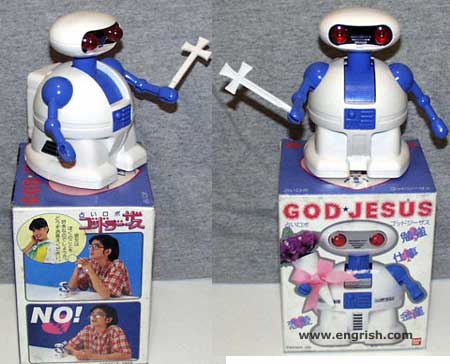
It looks like that guy is praying for a girlfriend.
GoGoArlo 10-12-2003 10:34 PM
...what the hell is that thing? Am i suppose to pray to that thing to make cute japanese school girls into liking me? Mmmmm, sacreligous.
Danial 10-13-2003 12:32 PM
almost everything in the entire series is a representation of something else. most of these symbols have more then one meaning or refrence. to make things even more complicated, some are even representations of symbols.

there is probably more then one meaning to the series.
The Fallen Phoenix 10-13-2003 12:49 PM
Wow...I am really, really impressed. I really think we have a winner here.

I've been struggling to find some kind of explanation to wrap everything together, and I really think this does it. Everything that happens in Big O makes a lot more sense if this underlying meaning as outlined above is true...

I don't see any flaws in the theory...I think it really brings all of the metaphors together...all I can say is excellent job. I especially like the memory parallel...I didn't even consider Platonic metaphysics (Hell, I haven't really thought of Platonic thought at all applying to Big O) as an explanation for the memories, but it definately makes a lot of sense. Wow, you really must have put a lot of thought, research, and effort into this theory...just for that I admire you, but I really think this is what brings everything in the show together.
Malkhos 10-13-2003 06:33 PM
I don't know the first thing about Japanese, so this is the kind of error I am prone to make.

I'm flattered you call my analysis Plotinian (and relieved some of the other members here know what that means). In fact I'm a classicist and a specialist in the Neopaltonsits and in Greek magic.

The whole reason I'm intersted in Big O is precisely because it seems to me so Gnostic, just like the Prisoner.

Sorry about any spoilers. The only palce I've psoted before is on Yahoo and I'm far from understanding all the etiquite here--For example, it seems as if some readers thought I would get monitoring the board and immediately engage with them. I had no idea--I didn't think there would be any response at all for hours or days.

Along those same lines, how does one go about getting an icon?
Malkhos 10-13-2003 06:40 PM
quote:
Originally posted by R Trusedale
quote:
Originally posted by zopwx2
Wow that is pretty in depth. I guess most of us knew there was some sort of underlying message, especially in the name choice of many of the robots. I just didn't have as much knowledge as you.


You didn't know, you believed there was some underlying message. There is a difference. After the very erudite theological treatise here, how much more deeply do you now understand the show? How much does the fact that some giant robots are named after ancient pagan gods really explain?


In ancient thought, knowledge (gnosis)--something possesed by the mind (nous)--was an intuitive recongition, and might be had without full understanding or any way to explain it. Something arrived by reason, on the other hand, was uncertian--an opnion, even if a demosntrably right opnion.
dawnstrider 10-13-2003 06:43 PM
I must say that I'm incredibly impressed. You certainly researched this thoroughly, and your incorporation of Platonic metaphysics is incredible. Again, it is always a possibility that we are looking too much into this, but speaking as a literary interpreter myself, this is a fine amount of brainwork that you have done.

Question: Do you see any type of positive eschatology - at least in regards to there stay at Paradigm - in the show? I may be misinterpreting, but that is the feeling I got when looking at your first and second points.
Malkhos 10-13-2003 06:43 PM
quote:
Originally posted by Big Doo-Oh
Definately a great anaylsis of Big O's meaning. I've never read the Bible, nor have I looked into any type of Pagan or Judeo-christian literature or philosophy. The only thing I think you missed was the importance of identity in Big O. I can think of at least three episodes where Roger has doubted his role, or who he is and why he is able to pilot the Big O.

Interestingly enough, he picked up upon whats going to happen in the end without even watching the spoiler clips.


This is what I was rying to get at. I think that some sort of identity between Big O, Dororthy (remeber she had piloted Big O also) and Roger will eventually be established.
Name Of God 10-13-2003 06:45 PM
quote:
Originally posted by Malkhos
Along those same lines, how does one go about getting an icon?


Just click "profile" on the top of the screen, and then click "avatar."

From there you can select one of default icons, or upload your own. (It has to be 100x100, and either gif, jpg, png, or bmp.) Smile
Malkhos 10-13-2003 07:01 PM
quote:
Originally posted by dawnstrider
I must say that I'm incredibly impressed. You certainly researched this thoroughly, and your incorporation of Platonic metaphysics is incredible. Again, it is always a possibility that we are looking too much into this, but speaking as a literary interpreter myself, this is a fine amount of brainwork that you have done.

Question: Do you see any type of positive eschatology - at least in regards to there stay at Paradigm - in the show? I may be misinterpreting, but that is the feeling I got when looking at your first and second points.


Well, thank you...but I've done ne research at all, I just dashed this off after watching the broadcast episodes (in fact I saw the whole first season with the soud off so as not to wake the baby)--if I was going to do any kind of research I'd have to watch the thing over and over again on DVD. Who know what one would find then? I recall an episode in which people start flocking into a church on the basis of restored memories and then are massacred (or do I have that garbled?).

The show seems set up to suggest that Big O will effect some kind of redemptive transformation at the end--on the order of replacing the corrupt Paradigm city that exists with a sort of New Jerusalem. But such expectations are often inverted and salvation shown to be impossible, as in Moby Dick, already mentined here, or The Natural (in the book--the positive eschatalogical expectation was restored in the film).